
In conversation with Maarten van der Veer
How can municipalities organize their elections as smoothly as possible? That is the question Maarten van der Veer grapples with every day. In his dual role as Consultant and Product Owner, he is responsible for Shift2: the application that enables municipalities to organize their elections in a streamlined manner.
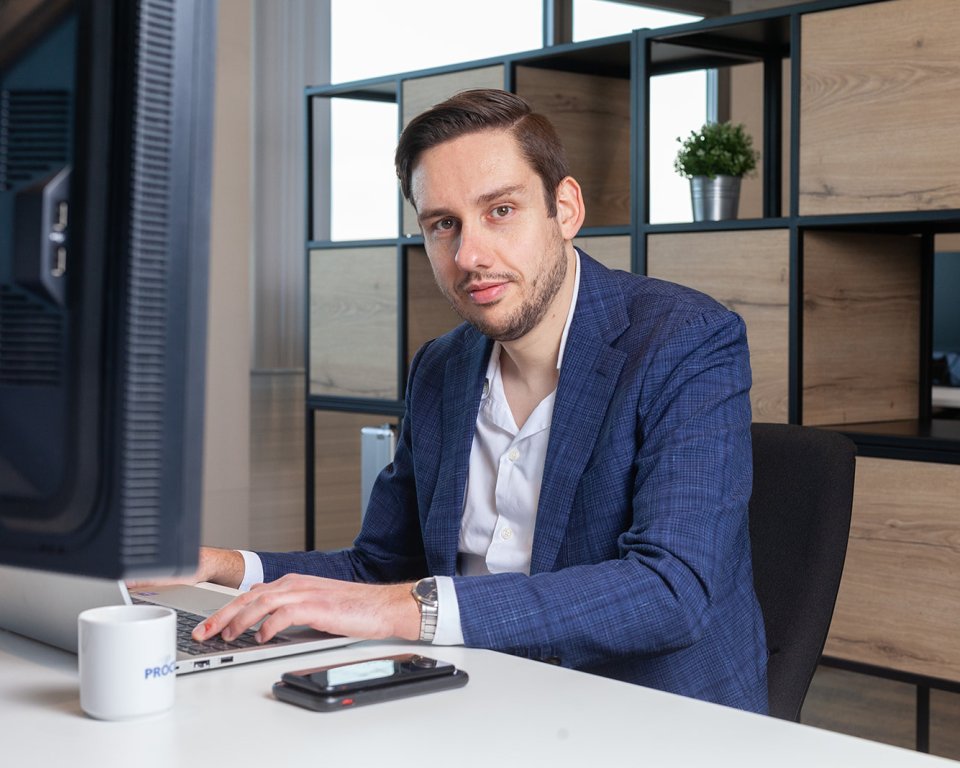
Maarten van der Veer is from Wageningen and has been working for Conxillium since 2009. He originally worked at GeoTax, but now he's a Consultant and Product Owner at Shift2. He can do his job on his own, which is exactly what he likes about Shift2. Plus, of course, the small team, where everyone has their own area of expertise and works closely together.
Maarten, can you tell us more about your dual role at Shift2?
“You can view elections as process-driven seasonal work: I work toward a specific day. Until that day and on that day, I work as a Consultant for the elections. But once election day is over, that role is no longer needed until the next elections are prepared. I can use the input I received in the run-up to the elections to improve our software. That is why I am both a Consultant and Product Owner of the software at Shift2.
In practice, this means that I help municipalities organize their elections and everything related to them. For example, I assist them in using the application, but I also help them tackle challenges surrounding the elections by exploring the many possibilities within Procura Elections together.
At the same time, I see and experience what happens on the work floor, what municipalities are planning, and where people get stuck. As Product Owner, I use that input to work with the developers to improve the application for the rest of the year, so that the municipality can hopefully work even better with our software solutions the following year. Think, for example, of the option to add polling station floor plans, or having Procura Elections automatically create a complete layout for the most suitable people for each position.
How do you take the pressure off municipalities as a consultant and product owner?
Most municipalities work with processes that have been in place for decades. But technology is changing rapidly, of course. That's why I try to help municipalities with challenges that arise around election time. These can be application questions, but they can also go beyond that.
It can be very helpful to take a critical look at the election procedure used:
- What are we working on?
- What is the best process to work with?
- How can we get more out of the application?
- And how can we improve our electoral process?
From a process support role, I try to help them with this and also answer the question: "How do you, as a municipality, ensure that the software solutions are designed in such a way that they fit in with how you want to work?"
When I visit, I demonstrate the many possibilities of the software solutions and how they can help make the election period more efficient. In some cases, I assist with a specific functionality. But more often than not, we go through the entire election process from A to Z.
We also offer remote assistance. We try to familiarize municipalities with our software by providing them with useful information. We share this information via the software, but also via our popular webinars.
Ultimately, my goal is to get municipalities excited about their elections again. The relief comes from being able to get the most out of our software solutions and elections. First and foremost in my advisory role, and then in my role as Product Owner, focusing on areas where the application can be improved. Talking, listening, and improving—that's how you could sum up my role."
What does a day at a municipality look like?
"My day always starts with coffee, of course, after which I log into the municipal environment together with the municipality and demonstrate the capabilities of our software. The municipality then knows what is possible and chooses the software solution that best suits the municipality's election process. The starting point is that the municipality's election process is leading and the software adapts to it. I do try to advise the municipality. With modern technology, a lot is possible. Some time-consuming tasks can now be done much more conveniently and efficiently with new software solutions.
During the visit, I set up the application according to their wishes. That way, when I leave, they feel confident that they can use it themselves. So I actually show them the application and click around with them, with the aim of not only demonstrating the software, but also its relevance to organizing the elections. We start at the beginning: "You start by organizing the elections..." and then we go through the application step by step.
The biggest challenge in organizing elections is ensuring that everything runs smoothly. There are quite a few variables involved, such as polling station officials, the communications department, IT to take care of the technology, and you want everything to go flawlessly. That is what we at Shift2 focus on most. Ultimately, we have the same interest as the municipality: ensuring that journalists only talk about the color of the pencils on the news. If we succeed in that, we know for sure that everything went well.
Another thing I do during a day at the municipality is visit the IT department. Our application runs in the cloud, which means that municipalities have to connect to it. But that can only be done via the municipal network. That's why I visit the IT department when necessary to discuss how they can arrange this. In that case, the connection is always set up quickly. With direct personal contact, connections can often be arranged quickly. But if I don't do that, there's a chance that the connection won't be made because the team has unanswered questions. And then the person who has to assign the polling station staff is left scratching their head. Of course, we want to avoid that."
What new developments do you see in your role as product owner?
If the government ever decides to introduce digital voting, it will be up to the Department of the Interior and Kingdom Relations to speak on the matter. Of course, voting computers can save a lot of time, because manual counting requires a lot of volunteers. That method of counting is based entirely on the four-eyes principle. The more eyes there are, the less chance there is of errors and fraud.
Ultimately, our voting method also relies on the perception that you may be able to say that you have an unhackable IT system, but all it takes is one person to claim otherwise and the count will no longer be accepted. Perception is very important in elections, as we have also seen in America.
Volunteers also bring a certain degree of social involvement. They are often people from the community itself, which makes it a celebration of the community and its residents rather than a national or regional event. It may be human work and take a lot of time, but it certainly has its advantages. In fact, I believe that you should continue to work with volunteers in any case. This way, you maintain the personal aspect and involvement of the local population.
As for our software, we will of course continue to develop it and make it as perfect as possible. As I said, we all serve the same interest: streamlined elections. By working on our application throughout the year, year after year, without being distracted by other matters, we can achieve that.
Want to streamline elections too?
With Shift2's election solution and a consultation with Maarten, you'll be up and running within a day.


